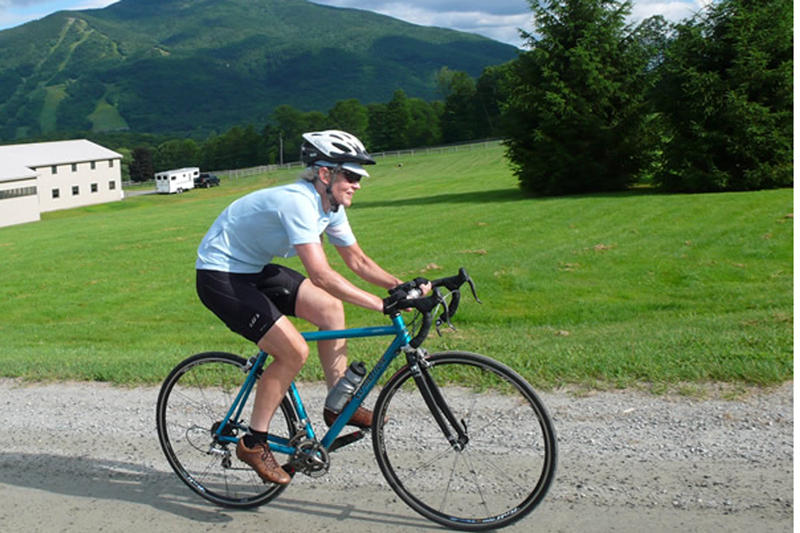
This is part two of an interview with Pamela Blalock, a versatile cyclist from New England, USA. If you missed the first part, you can read it here.Pamela Blalock, part 1
These sound to me like impossibly difficult rides, and
you mentioned that you have also participated in them on a tandem. When
was that?
In 1992, two tandems
completed BMB: one with two men, and the one I was on with my partner at
the time, Steve. I think there has been at least one tandem every year
since, but I don't know for sure. It is a challenging tandem ride. John
and I completed the ride on tandem in 1994.
Is
riding a tandem an advantage, disadvantage, or just a different
experience?
 I'm
going to say it's different. There are advantages and disadvantages.
You always have someone to ride with and talk to. But if something goes
wrong and one get sick or injured, you both have to slow or stop. On the
other hand, one can help the other through a rough spot. But one can't
ride off to get help if the bike breaks down. With the extra weight,
tandems are harder on parts. They also are going to be a bit slower up
hills and faster down. The tandem likely will climb at the average of
the two riders' paces. In our case John climbs faster than I do on a
single bike, so we climb faster on the tandem than I do alone, meaning
we go faster together than I would alone -- this is an advantage. But if
one has to stop to sleep/pee/eat, then both have to stop. Tandems can
be hard on parts, so chances of a mechanical may be increased. Finally,
the tandem is just harder on our butts -- which you can imagine is an
issue on a 750 mile ride. Being able to stand will help a lot in this
regard, but I do find I have to do a lot more standing on the tandem
than on my single. The reward for doing this challenging thing together
is amazing.
They are not races,
no one wins and stands on a podium, or gets ranked. And professional
cyclists are banned from entering. But that doesn't mean it is not
competitive and perhaps extremely competitive. How does participating
feel ... race-like or not so much?
Any
time two riders go out, it's competitive :-) PBP does recognize the
first finishers. The results book from 1991 and 1999 was listed by hour.
I believe now it may be alphabetical order. Everyone gets the same
medal, but it does have the time stamped on the back. At PBP, the front
end is very competitive. There are team tactics and some not so nice
things go on at the front. But for 95% of the riders, it's really all
about finishing. People help each other out and cheer each other on. It
is very friendly. Similar to a running marathon.
I
learned that the ride's "Great Book" lists the names of all successful
riders in it since the beginning in 1891. That's excellent, very cool!
I'm
going to say it's different. There are advantages and disadvantages.
You always have someone to ride with and talk to. But if something goes
wrong and one get sick or injured, you both have to slow or stop. On the
other hand, one can help the other through a rough spot. But one can't
ride off to get help if the bike breaks down. With the extra weight,
tandems are harder on parts. They also are going to be a bit slower up
hills and faster down. The tandem likely will climb at the average of
the two riders' paces. In our case John climbs faster than I do on a
single bike, so we climb faster on the tandem than I do alone, meaning
we go faster together than I would alone -- this is an advantage. But if
one has to stop to sleep/pee/eat, then both have to stop. Tandems can
be hard on parts, so chances of a mechanical may be increased. Finally,
the tandem is just harder on our butts -- which you can imagine is an
issue on a 750 mile ride. Being able to stand will help a lot in this
regard, but I do find I have to do a lot more standing on the tandem
than on my single. The reward for doing this challenging thing together
is amazing.
They are not races,
no one wins and stands on a podium, or gets ranked. And professional
cyclists are banned from entering. But that doesn't mean it is not
competitive and perhaps extremely competitive. How does participating
feel ... race-like or not so much?
Any
time two riders go out, it's competitive :-) PBP does recognize the
first finishers. The results book from 1991 and 1999 was listed by hour.
I believe now it may be alphabetical order. Everyone gets the same
medal, but it does have the time stamped on the back. At PBP, the front
end is very competitive. There are team tactics and some not so nice
things go on at the front. But for 95% of the riders, it's really all
about finishing. People help each other out and cheer each other on. It
is very friendly. Similar to a running marathon.
I
learned that the ride's "Great Book" lists the names of all successful
riders in it since the beginning in 1891. That's excellent, very cool!
 When
asking me about solo touring, people often suggest that I must be
particularly brave, or strong, or fast. I usually respond that I'm just
essentially stubborn. In your blog I read you describe yourself as
"Stubborn Pamela." Do you think that stubbornness is a characteristic of
cyclists?
Stubborness is not a bad
quality to have to keep pushing when you have nothing left. There are
certainly times that flexibility is called for, so I wouldn't say it's
all about being stubborn. I am persistent!
That's
a really good descriptor, I'll have to remember it. Also many people
say to me things along the lines of … why would you want to ride up
those hills? isn't that hard? There seems a bit of an implication that
it is a touch crazy. Well, maybe eccentric. And I have a hard time
explaining just how "addictive," or compelling, or fun it is. Does
something with a compelling or addictive quality like that happen with
long-distance cycling?
There is no
doubt this type of riding is addictive. There are some who can do PBP
once and then move on. I have not done a 1200km in many years now, but I
still do many of the other events (up to 600km). I just love to ride.
When
asking me about solo touring, people often suggest that I must be
particularly brave, or strong, or fast. I usually respond that I'm just
essentially stubborn. In your blog I read you describe yourself as
"Stubborn Pamela." Do you think that stubbornness is a characteristic of
cyclists?
Stubborness is not a bad
quality to have to keep pushing when you have nothing left. There are
certainly times that flexibility is called for, so I wouldn't say it's
all about being stubborn. I am persistent!
That's
a really good descriptor, I'll have to remember it. Also many people
say to me things along the lines of … why would you want to ride up
those hills? isn't that hard? There seems a bit of an implication that
it is a touch crazy. Well, maybe eccentric. And I have a hard time
explaining just how "addictive," or compelling, or fun it is. Does
something with a compelling or addictive quality like that happen with
long-distance cycling?
There is no
doubt this type of riding is addictive. There are some who can do PBP
once and then move on. I have not done a 1200km in many years now, but I
still do many of the other events (up to 600km). I just love to ride.
 Riders must qualify for these
endurance rides, completing a series of shorter, but still long rides,
of 200, 300 and 600k, I think. What other long rides do you participate
in, do you have favorites and if so, why?
My
favorite distance event is the Fleche. This is a team event, where 3 to
5 riders have a destination and 24 hours to get there, taking a route
of their choosing and covering at least 360km. I love the camaraderie of
this event. I've also done a few Gran Fondos in Italy. These are 200km
rides in mountainous areas with 10,000 of your closest friends. This
type of ride has recently arrived in the USA. These days I do a few 200
and 300km rides, usually a fleche, and then a few super short hill climb
races.
You have written that you
get a fair amount of training through commuting to work and that you
continue to ride in the New England winter. Do you do other kinds of
training and if so will you describe that?
I just ride, admittedly I ride a lot. I joke that if fitness is a side benefit, so be it.
Do you have any particular tours or randonnees planned for the next season or two?
Quadzilla!
Riders must qualify for these
endurance rides, completing a series of shorter, but still long rides,
of 200, 300 and 600k, I think. What other long rides do you participate
in, do you have favorites and if so, why?
My
favorite distance event is the Fleche. This is a team event, where 3 to
5 riders have a destination and 24 hours to get there, taking a route
of their choosing and covering at least 360km. I love the camaraderie of
this event. I've also done a few Gran Fondos in Italy. These are 200km
rides in mountainous areas with 10,000 of your closest friends. This
type of ride has recently arrived in the USA. These days I do a few 200
and 300km rides, usually a fleche, and then a few super short hill climb
races.
You have written that you
get a fair amount of training through commuting to work and that you
continue to ride in the New England winter. Do you do other kinds of
training and if so will you describe that?
I just ride, admittedly I ride a lot. I joke that if fitness is a side benefit, so be it.
Do you have any particular tours or randonnees planned for the next season or two?
Quadzilla!
For the reader who, like me, isn't familiar with the event, Quadzilla is an annual endurance ride held in the New York Finger Lakes region. It begins in Ithaca, NY and consists of four consecutive days each of 125 mile rides. When finished riders will have circled all eleven of the finger lakes. For more information and registration, visit Quadzilla.
Pamela, Thanks! You
have a great deal of useful information on long-distance
rides, specifically on training and qualifying, bikes, lights, shoes
& pedals, tires, and bags on your blog, The Blayleys: John and Pamela's Cycling Adventures. In addition to what is there, the reader will find more information and reports at The Blayleys,
not just about PBP and BMB, but about touring in France and other
countries, and all sorts of other things. Readers can find information about rides in their
area at RUSA (Randonneurs USA.)
Again, thank you so much for taking the time to answer these questions for me! Enjoy your 12,000 or so miles of riding in the coming year!
Pamela Blalock is an amazing cyclist. Her blog, The Blayleys: John and Pamela's Cycling Adventures and web site, The Blayleys, came to my attention recently while looking for information about New England randonnées. Now, I really mean those words in my masthead that say "Bicycles are wheels. You can do all kinds of things with them." So imagine how delighted I was to find Pamela's site, because she does in fact do all kinds of things with a bicycle ... rides tandem and solo, commutes, rides year-round, tours, races hillclimbs and is a randonneur. I was thrilled that she agreed to this interview, which is focused on randonneuring, defined by RUSA as "long distance unsupported endurance cycling." This is part 1 of our email interview.
 What drew you to cycling and how did that lead to randonneuring?
I have always ridden a bike. But my first exposure to club riding was also my first exposure to randonneuring. I met Gilbert Anderson through the North Carolina Bike Club. He had done PBP (Paris-Brest-Paris, described below) in 1979 and 1983, and he just told the most entertaining stories. He shared stories about French people in the little villages inviting riders into their homes in the wee hours, and climbing over fences on some ride where the route sheet sent them down a dead end trail, and of going into a convenience store to buy panty hose to keep warm. His stories were funny and romantic and just made me want to do these rides. I did a 100km ride and was hooked. I'm not sure how I jumped straight from 100km to 300km, but I did, and while it was hard, I was so excited when I finished. And I never looked back!
What drew you to cycling and how did that lead to randonneuring?
I have always ridden a bike. But my first exposure to club riding was also my first exposure to randonneuring. I met Gilbert Anderson through the North Carolina Bike Club. He had done PBP (Paris-Brest-Paris, described below) in 1979 and 1983, and he just told the most entertaining stories. He shared stories about French people in the little villages inviting riders into their homes in the wee hours, and climbing over fences on some ride where the route sheet sent them down a dead end trail, and of going into a convenience store to buy panty hose to keep warm. His stories were funny and romantic and just made me want to do these rides. I did a 100km ride and was hooked. I'm not sure how I jumped straight from 100km to 300km, but I did, and while it was hard, I was so excited when I finished. And I never looked back!
Probably because it is held in France, before discovering your site I knew a little bit about PBP, but nothing about BMB. Will you describe these rides?
PBP stands for Paris-Brest-Paris. It is a 1200km (750 mile) ride from Paris out to Brest on the coast and back. Riders have up to 90 hours to complete the event. The clock does not stop. So the 90 hours includes riding time, eating, sleeping and all other stops. PBP is held once every 4 years and was first held in 1891. Originally it was a professional race that, because it was so difficult, was held only every 10 years. In the 50's it became an amateur event and went to every 5 years, and then every 4. The last running, in 2011, had about 6000 participants from all over the world.
In 1988, inspired after doing PBP, a couple of guys from Boston conceived the Boston-Montreal-Boston 1200km ride, with the same format. Until then, there were no other 1200kms aside from PBP.
 How is the culture of PBP and BMB different?
BMB had at most about 150-160 riders. PBP has 6000 riders. You are almost never alone at PBP. There are cheering spectators lining parts of the route in France. Crowding at controls can cause delays at PBP. At BMB, if you end up riding alone, you might not see anyone else for a long time. PBP has massive support from the locals, at all hours, day and night, and everywhere. Lots of press, lots of folks at controls. Everyone knew what was going on. At BMB, no one along the route has a clue what BMB is. You are likely to get blank stares at convenience stores as you come in during the wee hours to buy something. When they find out you are on a long ride, the first question is what charity are you riding for, and folks seem offended if you aren't doing a charity ride.
How is the culture of PBP and BMB different?
BMB had at most about 150-160 riders. PBP has 6000 riders. You are almost never alone at PBP. There are cheering spectators lining parts of the route in France. Crowding at controls can cause delays at PBP. At BMB, if you end up riding alone, you might not see anyone else for a long time. PBP has massive support from the locals, at all hours, day and night, and everywhere. Lots of press, lots of folks at controls. Everyone knew what was going on. At BMB, no one along the route has a clue what BMB is. You are likely to get blank stares at convenience stores as you come in during the wee hours to buy something. When they find out you are on a long ride, the first question is what charity are you riding for, and folks seem offended if you aren't doing a charity ride.
What is the demographic of the participants like in the two races? I assume that both draw international participation.
Folks come from all over the world to do PBP. In the years it was run, BMB got a few Canadians, Irish (how I met John), English and French. Most of the American 1200km rides have mostly American riders, with a few from somewhere farther afield. PBP is truly international and gets even more so with every running.
I've often thought that cycling gets so little coverage in this country, and women's cycling is really not on the public's radar at all. Although the first women riders in PBP were in 1931, you are the first woman randonneur whom I've read about. Has women's participation in endurance cycling changed since you've been involved?
 I took part in the first BMB, along with 18 other riders, 4 of whom were women. One of those women got lost and did some bonus miles before getting a lift back on route and finishing (unofficially). So all 4 women "finished," but one was listed as unofficial. The first year likely had the highest percentage of women participants.
There are a few women in the area who do these types of events. One is Melinda Lyon, who has finished as the first woman at PBP several times. She has also done BMB many times, as well. Another local gal, Emily O'Brien, has done BMB, PBP, and Endless Mountains on a fixed gear bike. She has also completed Furnace Creek, a RAAM (Race Across America) qualifier on fixed gear. Women make up a small percentage of randonneurs relative to men, but there are still quite a few women throughout the US doing these types of rides.
As for my track record, I attempted PBP in 1987 and did not finish. But I did finish BMB the next year. I went back and had a successful PBP in 1991. I did BMB on tandem in 1992 with my partner Steve, and in 1994 with John, who later became my husband. John and I also did PBP on tandem in 1999.
Do you try to keep to any particular strategy or tactics?
I like to make effective use of the allowed time. I typically try to get 5 hours of sleep a night, and take time to eat meals at each control. But otherwise I am riding. To paraphrase and clean up the language of one of my friends, time not spent riding, eating or sleeping is wasted time. Eating is a big concern and a challenge. It's important to eat on and off the bike, and to find the right balance, eat enough to get through, but not so much that you puke when you ride up hills!
Good preparation is vital, both for the body and bike. I have often described brevets at 95% mental and 95% physical. I think you must have both.
It's important to have a reliable bike and to be able to fix any issues. I have become a pretty good bike mechanic as a result of either learning to fix something on the side of the road, or better yet, learning about and preventing issues beforehand. Since riders must complete a series of 4 rides of increasing length (200km, 300, 400 and 600) before attempting a 1200km, they and their bikes should be well-prepared by the time the 1200km comes around.
Is falling asleep at the handlebars a danger ?
I always try to ride with other people, especially at night. Conversation is one of the best ways to avoid the "noddies," nodding off to sleep. Plus it's just more fun and makes the miles pass by quicker. For me, pre-dawn is the toughest time. Once the sun comes up, I am awake again. So I try to arrange sleep stops for that time. One of the great things about riding the tandem is always having company.
I took part in the first BMB, along with 18 other riders, 4 of whom were women. One of those women got lost and did some bonus miles before getting a lift back on route and finishing (unofficially). So all 4 women "finished," but one was listed as unofficial. The first year likely had the highest percentage of women participants.
There are a few women in the area who do these types of events. One is Melinda Lyon, who has finished as the first woman at PBP several times. She has also done BMB many times, as well. Another local gal, Emily O'Brien, has done BMB, PBP, and Endless Mountains on a fixed gear bike. She has also completed Furnace Creek, a RAAM (Race Across America) qualifier on fixed gear. Women make up a small percentage of randonneurs relative to men, but there are still quite a few women throughout the US doing these types of rides.
As for my track record, I attempted PBP in 1987 and did not finish. But I did finish BMB the next year. I went back and had a successful PBP in 1991. I did BMB on tandem in 1992 with my partner Steve, and in 1994 with John, who later became my husband. John and I also did PBP on tandem in 1999.
Do you try to keep to any particular strategy or tactics?
I like to make effective use of the allowed time. I typically try to get 5 hours of sleep a night, and take time to eat meals at each control. But otherwise I am riding. To paraphrase and clean up the language of one of my friends, time not spent riding, eating or sleeping is wasted time. Eating is a big concern and a challenge. It's important to eat on and off the bike, and to find the right balance, eat enough to get through, but not so much that you puke when you ride up hills!
Good preparation is vital, both for the body and bike. I have often described brevets at 95% mental and 95% physical. I think you must have both.
It's important to have a reliable bike and to be able to fix any issues. I have become a pretty good bike mechanic as a result of either learning to fix something on the side of the road, or better yet, learning about and preventing issues beforehand. Since riders must complete a series of 4 rides of increasing length (200km, 300, 400 and 600) before attempting a 1200km, they and their bikes should be well-prepared by the time the 1200km comes around.
Is falling asleep at the handlebars a danger ?
I always try to ride with other people, especially at night. Conversation is one of the best ways to avoid the "noddies," nodding off to sleep. Plus it's just more fun and makes the miles pass by quicker. For me, pre-dawn is the toughest time. Once the sun comes up, I am awake again. So I try to arrange sleep stops for that time. One of the great things about riding the tandem is always having company.
This is the first part of our interview. For Part 2 of Pamela's interview, click here.

 I'm
going to say it's different. There are advantages and disadvantages.
You always have someone to ride with and talk to. But if something goes
wrong and one get sick or injured, you both have to slow or stop. On the
other hand, one can help the other through a rough spot. But one can't
ride off to get help if the bike breaks down. With the extra weight,
tandems are harder on parts. They also are going to be a bit slower up
hills and faster down. The tandem likely will climb at the average of
the two riders' paces. In our case John climbs faster than I do on a
single bike, so we climb faster on the tandem than I do alone, meaning
we go faster together than I would alone -- this is an advantage. But if
one has to stop to sleep/pee/eat, then both have to stop. Tandems can
be hard on parts, so chances of a mechanical may be increased. Finally,
the tandem is just harder on our butts -- which you can imagine is an
issue on a 750 mile ride. Being able to stand will help a lot in this
regard, but I do find I have to do a lot more standing on the tandem
than on my single. The reward for doing this challenging thing together
is amazing.
I'm
going to say it's different. There are advantages and disadvantages.
You always have someone to ride with and talk to. But if something goes
wrong and one get sick or injured, you both have to slow or stop. On the
other hand, one can help the other through a rough spot. But one can't
ride off to get help if the bike breaks down. With the extra weight,
tandems are harder on parts. They also are going to be a bit slower up
hills and faster down. The tandem likely will climb at the average of
the two riders' paces. In our case John climbs faster than I do on a
single bike, so we climb faster on the tandem than I do alone, meaning
we go faster together than I would alone -- this is an advantage. But if
one has to stop to sleep/pee/eat, then both have to stop. Tandems can
be hard on parts, so chances of a mechanical may be increased. Finally,
the tandem is just harder on our butts -- which you can imagine is an
issue on a 750 mile ride. Being able to stand will help a lot in this
regard, but I do find I have to do a lot more standing on the tandem
than on my single. The reward for doing this challenging thing together
is amazing.  When
asking me about solo touring, people often suggest that I must be
particularly brave, or strong, or fast. I usually respond that I'm just
essentially stubborn. In your blog I read you describe yourself as
"Stubborn Pamela." Do you think that stubbornness is a characteristic of
cyclists?
When
asking me about solo touring, people often suggest that I must be
particularly brave, or strong, or fast. I usually respond that I'm just
essentially stubborn. In your blog I read you describe yourself as
"Stubborn Pamela." Do you think that stubbornness is a characteristic of
cyclists?  Riders must qualify for these
endurance rides, completing a series of shorter, but still long rides,
of 200, 300 and 600k, I think. What other long rides do you participate
in, do you have favorites and if so, why?
Riders must qualify for these
endurance rides, completing a series of shorter, but still long rides,
of 200, 300 and 600k, I think. What other long rides do you participate
in, do you have favorites and if so, why?