December 27, 2017

La Vélodyssée

June 2017. La Vélodyssée: The section of EuroVélo 1 that passes through France. The approximately 800 miles of absolutely beautiful, mostly car-free, signposted route that travels from Roscoff to Hendaye.  Roscoff, in Brittany on La Manche ... we call it The English Channel. ... to Hendaye, on the Spanish border and the Atlantic.


Here is a list of my posts, click on any one or start at the beginning. The next button will  lead you along my ride.

Beginnings
Voie Verts and Canals
C'est Quoi? What?!!?
Art and Bikes along the Loire
Tides
The Atlantic
Travelling
Time Shift
Retrospective

Retrospective

I didn't know what to expect of this ride, didn't have any fixed idea of whether or not I would stick to the designated route. I carried my standard yellow Michelin maps, in case I chose to abandon. There was a reason for my cautious attitude.

Years ago, 2009, I rode the Canal du Midi as part of a longer ride. Though the boats, not to mention the people on them, along with the locks and buildings were fascinating, cyclists could rarely see the world beyond the canal banks. The  ancient plane trees provided welcome shade, and as a side effect caused the riding to be painfully slow .... the roots of those same plane trees projected out of the ground 2, 4, 6 inches, again and again, making it impossible to gather any momentum whatsoever. So I began this long ride with some trepidation about off-road riding.

I need not have fretted, it was a delight, especially after I realized that cycling on rough surfaces with a heavily loaded bike was going to be slow going and commensurately slowed down my overactive brain.   The route turned out to be virtually always so totally enjoyable, varied and beautiful. Riding without any concern whatsoever about cars, not needing any ear out for what was approaching from the rear, turned out to be unexpectedly liberating. It's true, one needed a sharp eye for signs. It's true, the handy guidebook La Vélodyssée (in French), published by Le Routard, was a great aid, as was the official website La Vélodyssée 1 (in English.)  I saw many other riders with one form of GPS or another, which seemed to help them stay on route. Generally though, the route was very well signposted, and no problem to follow.

Once south of the Loire, the Atlantic  was generally on my right: the landscape, seascape was amazingly gorgeous.


It was sometimes disconcerting to have so little sense of where I actually was, in the bigger picture. I think that was caused by not using large paper maps, and so not having reference to my position relative to named places on the map. In all, I rode about 950 or so miles. That is longer than the designated route, as I often rode away from the route to find a campground, or rode into town to find meals or supplies. In some cases the route turned a block or so before a potentially good place to eat. Located just past the turn, this boulangerie made sure all cyclists noticed it ... I appreciated the sign, and it was great for a second breakfast


Lunch? Dinner? Yummmmm ... once near the ocean there were oysters, lots of oysters. And totally delicious fish. Oysters for appetizeres, fish for the main course. That is almost all I ate. And ate it with enthusiasm. Put me in the sun, at the end of the day, tired muscles, a good hot shower, with a glass of wine, oysters, and fish. Make me happy.


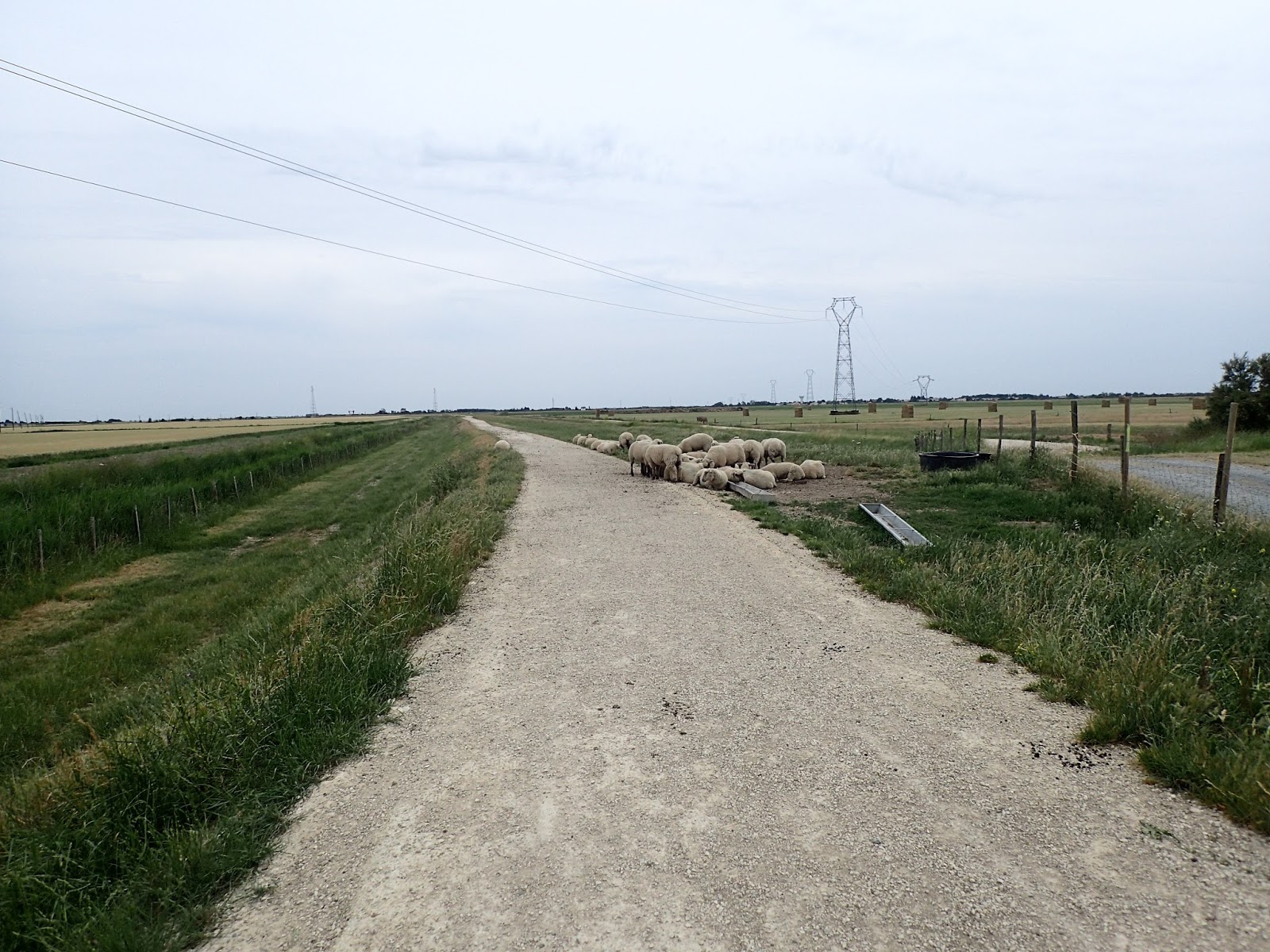
I camped most nights, and so met more fellow cyclists than on any previous trip, they too drawn to the long, marked route. This route is not for you if you mind flat: it is one very flat route. Gorgeous, but flat. That was not a complaint for me. The surface was varied, sometimes packed dirt or limestone, sometimes gravel, sometimes paved. It varied from wide enough for both bikes and pedestrians to narrow paths through salt marshes or on the top of digues.


Often I could walk from the campground to the Atlantic, with its miles and miles of protected coastline and extraordinarily wide beaches. Wider than I have ever before seen.


For whatever reason, I don't remember, I stopped posting after the great dune at Pilat. Perhaps it was the heat ... there was a heat wave, over 100 F, hot enough that even strangers, behind me in line at 8 am, as I was buying food for lunch, insisted that I stop at noon, get out of the sun, pay attention and be safe. I never stopped that early, but I did start early, and stopped by mid-afternoon.


Biarritz was such fun; it reminded me a bit of Nice, on the Mediterranean where I finished my Paris-Nice ride. Historic, chic, party-town, extremely good food, fun.


I finished up in Hendaye, on the Spanish border. The heat wave had broken, the last day of the ride was drizzly with low visibility. There was no cycling route, for the first time in about 900 miles I was on roads ... roads that were too small for all the hurried, harried, angry drivers. It was no fun and far too stressful. I took the train for the last 15 miles or so into Hendaye. A symmetry there, I think, as the route unexpected began with a train strike.

As I (finally) write this, it has been about six months since I'm back from France. Just about time to return there.


June 19, 2017

Time shift


Time compacts, though whether minute by minute or hour by hour, I leave to science. A musician and fellow long-distance rider I met further north said it mushes together. He is correct. I try to grab it, suck in the views, the smells, the efforts and experiences, imprint them on my mind, bury them in my body.


Why, and how, does this happen? I suspect a combination of traveling through time and space, experiencing constantly something new, and travelling with effort. Recently with quite a lot of effort. This isn’t the hardest riding I've done, but it is incrementally hard and that adds up. It is the weight of four bike panniers and a loaded handlebar bag. The past several days it is also the heat, with a notable heatwave here in France.


Mornings always seem to start off lovely. Sleep, food, weather determine the start and thus far I have been lucky in all three. “Road” surfaces kick in, that is to say: it is the surface that counts, I am virtually never on a road. Here, in the south, the surface is often paved, making for easy riding.


Muscles that start off tight loosen up and energy is high. For days now I have ridden along the coast. Sometimes with the Atlantic in view, sometimes in the dunes defining the border between sea and land. Occasionally across those dunes, constantly up and down, hard riding. These dunes are measured by the hundreds, not the tens, of feet. Days are gorgeous, impossibly beautiful, I am so very lucky.

Then, I suppose, the kilometers kick in. Fifty-fifty, Sixty-five. Seventy. The afternoon sun asserts itself. It gets hotter. I get fatigued. The weight on my lovely, dependable, capable bike starts making itself felt.Those are probably the only reasons why the end of the day always feels so much harder. Reasons enough.

Pretty much daily, 75 – 85 k after beginning, I find myself in another campground. Set up my tiny tent, shower, find dinner. Try to grab those memories of the day before they slip into a continuum with previous days. Recently I camped at the astonishing dunes of Pyla, near Arachon.


Tomorrow I continue south, through this constantly changing countryside.

At some point during each of my long rides, my experience of time changes. Pushing pedals around, looking for turns, chatting from time to time with other riders, watching and smelling the world around me, becomes just what I do, what my world is about.


The days pass one after the other, while I try to hold onto each experience. But still I marvel, just when was it that I shared the ferry across the Gironde with those two other cyclists?

NEXT


June 16, 2017

Travelling

Odd, or silly, I'm sure: somehow it felt as if I wasn't moving at all.


I knew I was pedaling, but the feeling was as if I was on a stationary bike, the world around me some kind of slowly changing virtual reality or video. Flat, it was very flat. To the horizon in all directions there were fields of wheat, sunflowers, corn. I knew I was moving, but … really?


With no real sense of direction, or of my true location, it felt as isolated as the high remote peaks, and valleys, of the Pyrenees. That is foolishness. Other cyclists were rare, though I saw many signs of aquaculture ...oysters, shrimp, maybe other shellfish.

Continuing sometimes on narrow tracks, sometimes double, my route a rough mixture of white stone and shells, it continued… beautiful slow riding.


The air warm, humid, and so salty I could feel and taste it. Crossing digues … dikes, I think built to manage human's relationship with the sea. Rather than the sea managing us.


Construction blocking the route, with no detour signs. In a marked route of 1250k, normal enough. I circled, searching for a route to continue southward.


And I found great, marshy bird habitat, birds familiar to those at home, but not the same species.


This was the first time in all these years of touring that it felt truly like long-distance riding. It didn't much matter how far I rode. What mattered was continuing to pedal, and continuing to pay close attention to the world I travel through. Because I was indeed moving.

NEXT


June 13, 2017

The Atlantic

Beautiful. Or maybe stunning, to be more modern in language.


That is about the best I can do to describe the 92k ride to La-Tranche-sur-Mer, where I lucked on an excellent campsite. Plus, I am too tired to be coherent, I suppose. So, here are some photos of the landscape.


And here are some of the people I saw enroute.


People often tell me they think I'm brave, or courageous, or some such. I am not sure what I think about that, because I don’t feel either thing. But I do think it brave to pull a baby for hundreds and hundreds of miles, as this young couple was.


June 12, 2017

Tides


It's true. Unlike my other long rides in France, before beginning this one I did very little reading about the regions I would be passing through. No history books, no memoirs, no travel guides. And no excuses or explanations offered. Plus, this region of France was not embedded in my memory in high school or college classes the way that other regions were. I tell you that to admit that often I do not have a big picture view of quite where I am, geographically. That knowledge is not so needed, because the ride, day by day, brings immense pleasure and its own challenges.


When I arrived at the bridge above, Monique and Pierre were there, cyclists I recognized from the previous night's camping. I was puzzled by the scene in front of me and asked, essentially, what happened to the water in the river? They said: the tide is out. And wow! What tides they are. Not the strongest in France, that honor goes to a region further north, but close. It wasn't so much a river as an estuary, we were so close to the ocean.

I stopped not much later, and enjoyed lunch with this extraordinary view.


The day got long, by happy chance I saw Monique and Pierre again, and they graciously included me in the search for a camp site for the night, stopping at corners to make sure I saw the route and let me catch up.

At the campsite another rider we had seen the night before, Jean-Louis, arrived a bit later, and we enjoyed a filling, impromptu, dinner sharing what we each had to eat.


The next morning we set off for the Passage du Gois. For me it was totally amazing and such fun. I had no idea such a road could exist.  When we arrived we waited for about an hour for the tide to drop.


The Passage de Gois was first mentioned on books in the 16th century. But it has been travelled on  since long before that. It is a stone-paved causeway (now also sometimes asphalt) that is flooded twice a day by the tide. Passable only for 3 hours, 1-1/2 hour before and after low tide, the rest of the time it is covered by 5 to 13 feet of water.


Signs advise travelers to seek safety on the towers if caught unawares by the tide.


Seaweeds attach to the roadbed and even when I was there at very low tide the water crept up the roadway.


Residents venture out to collect shellfish.


I had no idea what the day's ride would bring ... such a delight!

NEXT


June 9, 2017

Art and bikes along the Loire


If you had asked me a few days ago how I imagined the Loire, I would have mentioned huge historic chateaux, and of course vineyards and fine wine. Now I would mention a humorous active support of public art, and working ports with industry.


This house in the Loire, intentionally tilting, is the work of artist Jean-Luc Courcoult, and according to the artist is imaginary ...because it introduces a dream like quality into people's lives ... realism, grounded in reality.


Imagine the enormous bicycles that require bicycle stands as big as these! Never this big, there were bicycles everywhere, with many many loaded touring bikes. More than I have ever seen.


There was a free bac .... ferry ... to cross the Loire. That is a wide long river, muddier than the Rhone where I have seen it. I am not sure, but it may be the longest river in France. With the Rhone, one of the most historic.


It seems that everyone offers to help everyone else. I stopped on the side of the road for lunch, a couple coming the other direction saw my bike on the ground but not my sandwich and stopped to make sure all was ok. People have approached me several times to offer directions and assistance when they have seen me looking at a map. And several times it has really helped! I have done the same occasionally though I am not in a position to be much help. I have managed to learn a few lessons about route finding without making any major blunders.


I am now south of the Loire, in a 3-star campsite where my site has glimpses of the Atlantic. The end of today's ride took me past the two places in these last photos.


NEXT


June 7, 2017

C'est quoi? What?!!?

There is always something to look at here, frequently beautiful whether big or small, and always interesting.


The last several days have continued to follow the canal Nantes-Brest, which is considerably more fun than the Canal du Midi where I rode in 2009. That is because this is more open … more views out and around. Plus, the riding surface is much better, without huge sycamore roots providing constant bumps. The exception proves the rule.


There are all kinds of boats.


The route was sometimes marked Barré. Closed. Like most cyclists, I understand that to mean closed to something, but not to bicycles. Without worry, I continue on my designated route. Then I arrived at a bright yellow and black tape closing the canal path. I could see another, about 150 meters on. I could see no problem, no disruption. Should I disregard it and duck under? But, there were two gendarmes, and a police van with a blinking blue light, to the side of the canal path. Reason, or age, took over and I went to talk to them.


This is my best approximation in English of our conversation in French:

“Good afternoon gentlemen, I need to continue to Josselin, is there another route?

Yes turn right continue to just beyond the lake, turn left then again left, then right again.

There is no little road, just go through the field?

Yes.

But why is the canal path closed? I don't see anything.

There is a grenade. It was just found today.

Yaooschkkk! Did you say a grenade? A grenade? How did it get here?

It is a grenade left from the Second World War.”

I have read about this, but never imagined to see it. They told me it isn't completely unusual. Unusual enough for this rider.

NEXT


.